Among these unhappy mortals is the writer of dictionaries, whom mankind have considered, not as the pupil, but the slave of science
—Samuel Johnson, A Dictionary of the English Language
Introduction
A central aim of neural network interpretability is to find meaningful concepts in the jungle of activations these networks create. Recent research has shown that a representation learning method, sparse dictionary learning, can extract meaningful features from a neural network. In this vein, we develop a dictionary learning system of our own on a one-layer transformer using a custom dataset. This paper outlines our design, the features we found, and the scaling laws we discovered. This includes the result that the percentage of nonzero-feature scales inversely with autoencoder size in our model.
Background on Autoencoders for Interpretability
Our dictionary learning system is based on the systems developed by Anthropic in “Towards Monosemanticity”. “Sparse Autoencoders Find Highly Interpretable Features in Language Models” also deserves responsibility for the development of dictionary learning as an interpretability method. An in-depth description of dictionary learning is available on Kola Ayonrinde’s blog.
Our Dataset, Transformer Design
To incorporate a wide variety of features, we chose our dataset to incorporate a wide variety of languages with many symbols. Most of our data (around 70%) came from C4. The rest of our dataset includes Wikipedia from a variety of languages as well as a few other sources (see Appendix).
In the design of our transformer, we tried to keep close to Anthropic’s design. Therefore, we chose to build a one-layer, 8-head transformer. We trained for 28000 iterations, with a batch size of 64 consisting of sequences of 1024 tokens. We used the GPT-2 tokenizer.
Our Autoencoder Design:
For our autoencoder, we followed a broadly similar design to Anthropic’s as well. In order to prevent dead features we used Anthropic’s resampling procedure outlined in Towards Monosemanticity. We trained autoencoders with 512, 1024, 2048, 4096, 8182, and 16384 features.
Examples of Interpretable Features:
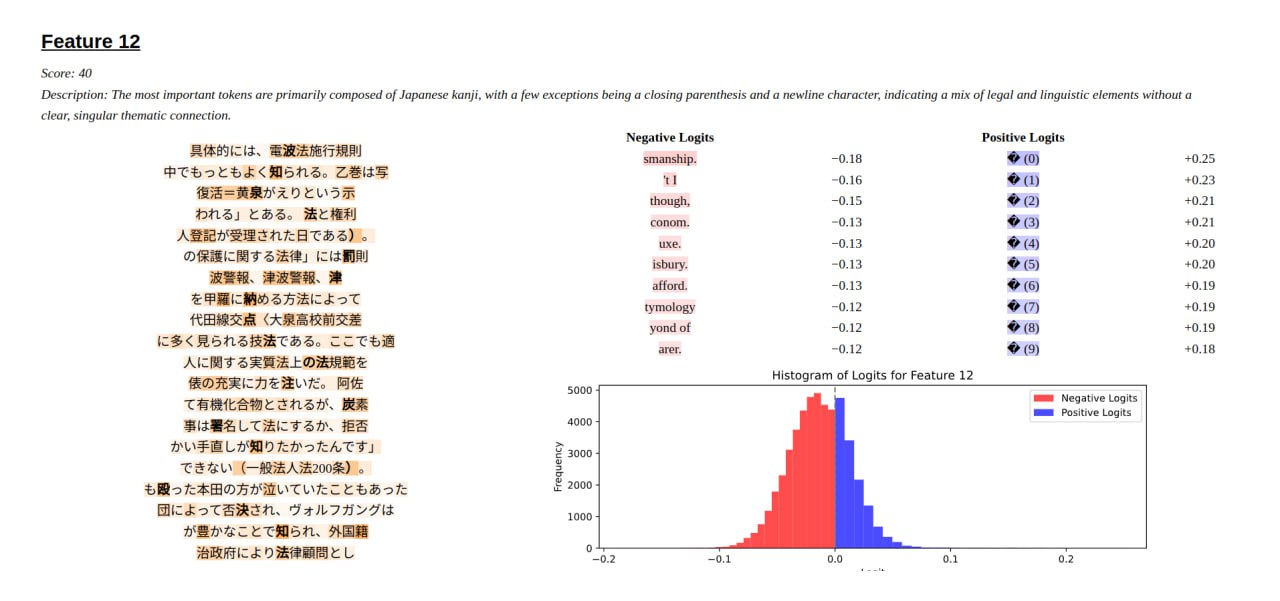
Interpretable Features Found in Our 1024 and 4096 Autoencoder
Cool Features for Autoencoder 1024:
Cool Features for Autoencoder 4096:
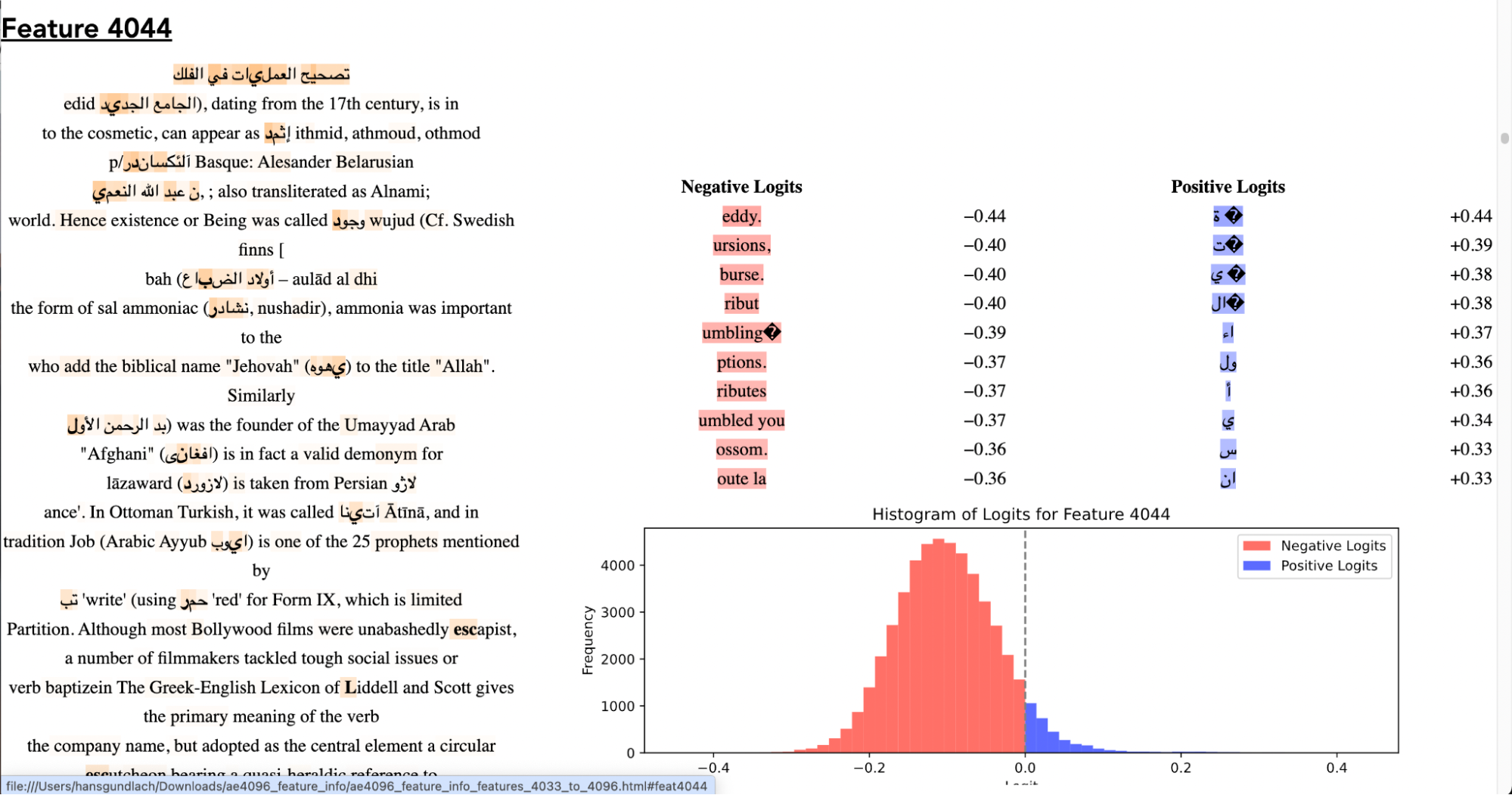
Even though we were able to find interpretable features, it was hard to find features that had both interpretable max activations and interpretable logits that matched the max activations. We would guess that more than half of our features that had interpretable max-activations did not have interpretable logit attributions. This may suggest errors with our logit attribution or max-activation sampling. However, when we tried steering our transformer by adding our given logit attribution vector to the activations, our transformer produced outputs that were coherent with the given logit attribution.
Scaling of Low-Density Features with Autencoder Size
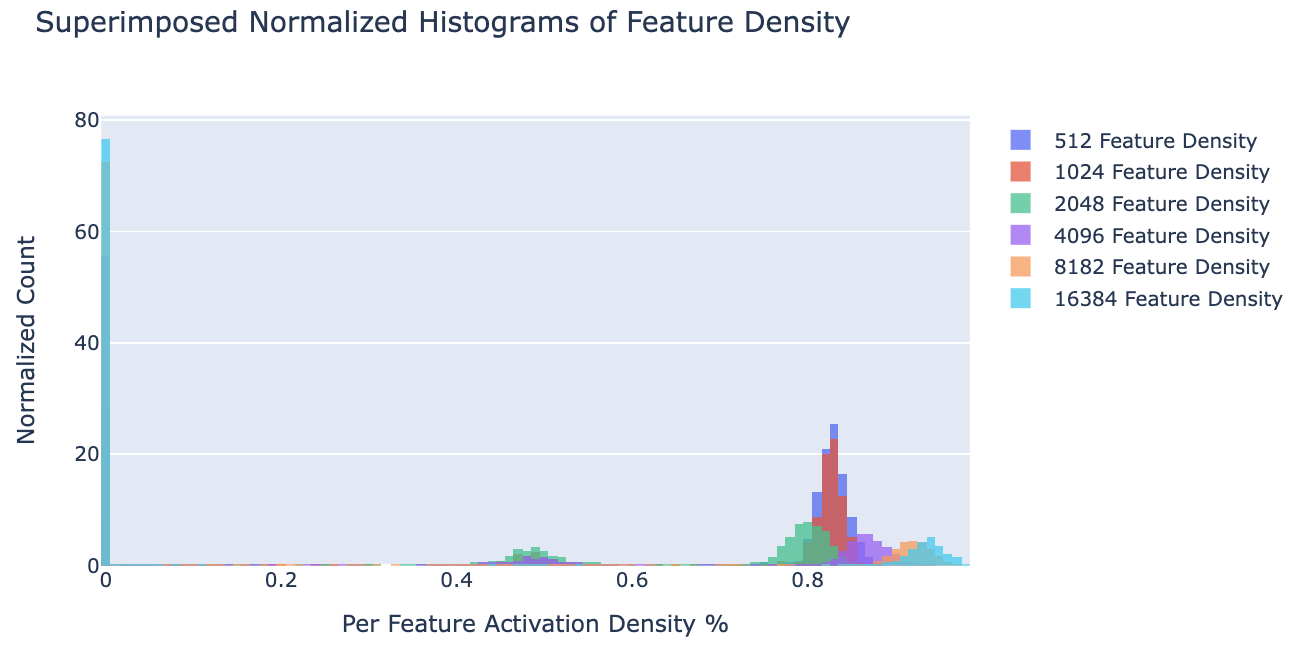
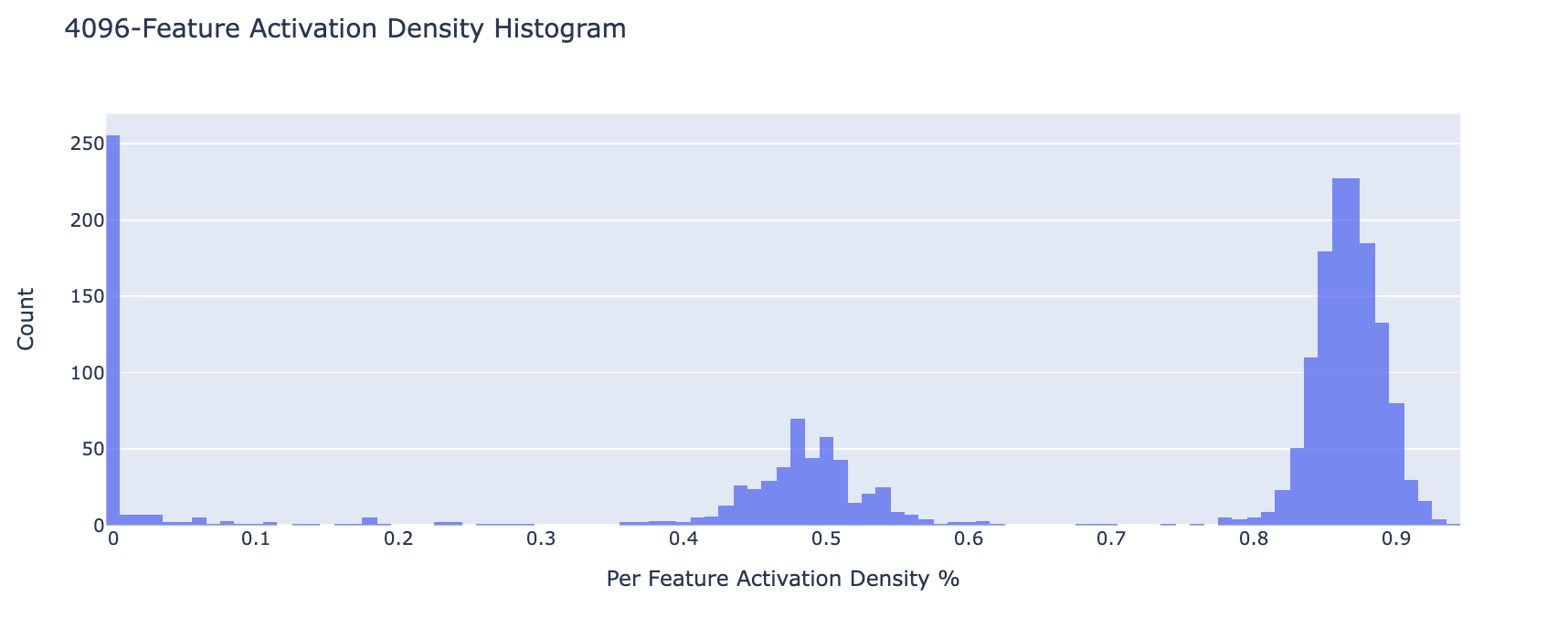
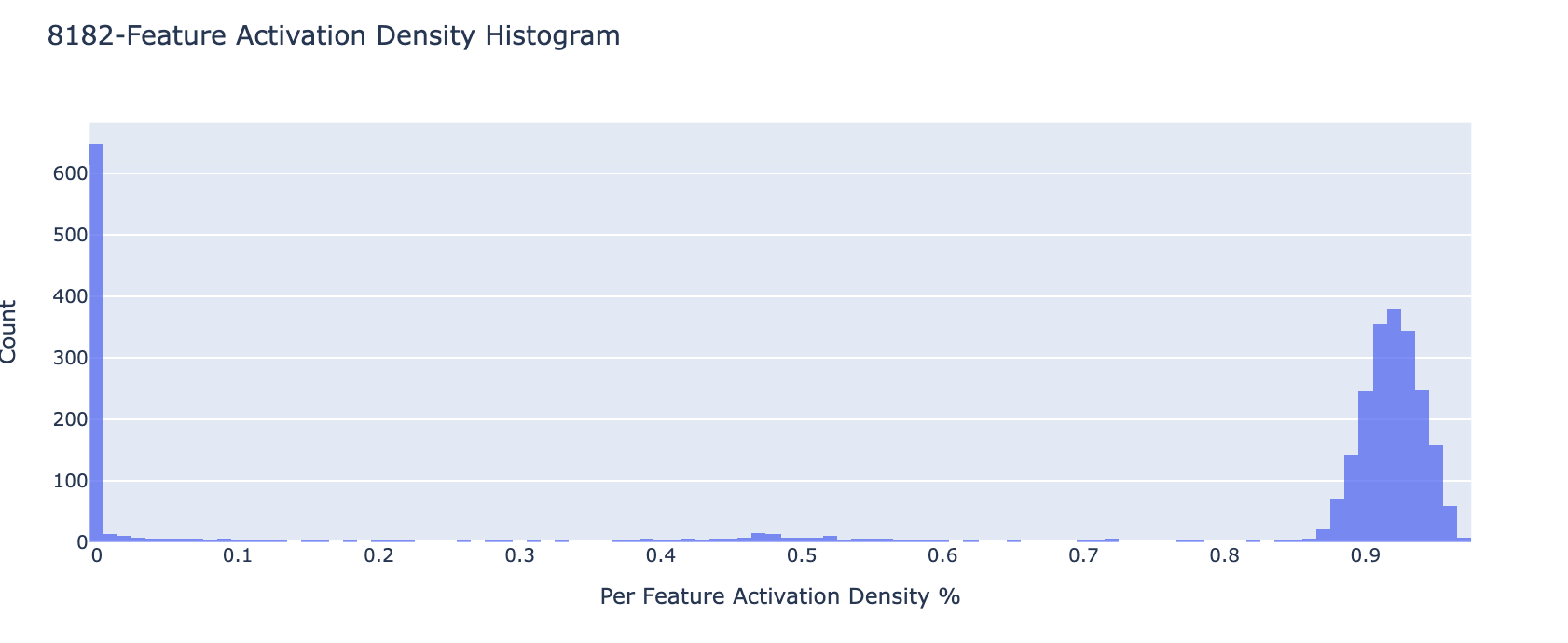
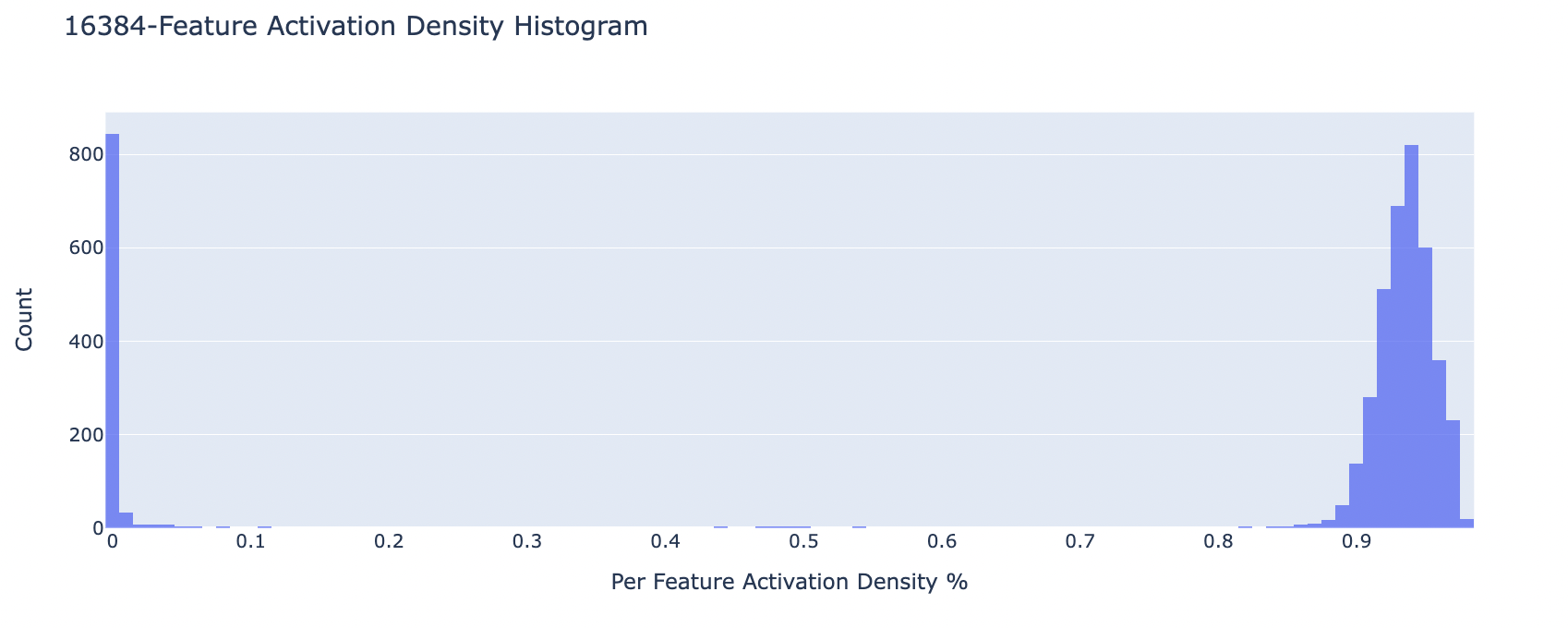
So how do the features change as we increase the size of the autoencoder? Naively, as the number of encoded features increases each feature should correspond to a more specific section of the data. For example, as the number of features increases we should have features for math in Russian vs just math. The process by which this happens is known as feature splitting. This means that as autoencoder size increases the density of an individual feature decreases. Overall this is the pattern we observed. However, when the number of features increased in our autoencoder we noticed that the number of “dead” features grew consistently. Here we use dead and ultralow density features (active on less than about 1 in tokens) synonymously as we were not able to distinguish features with such a low density in our largest autoencoders.
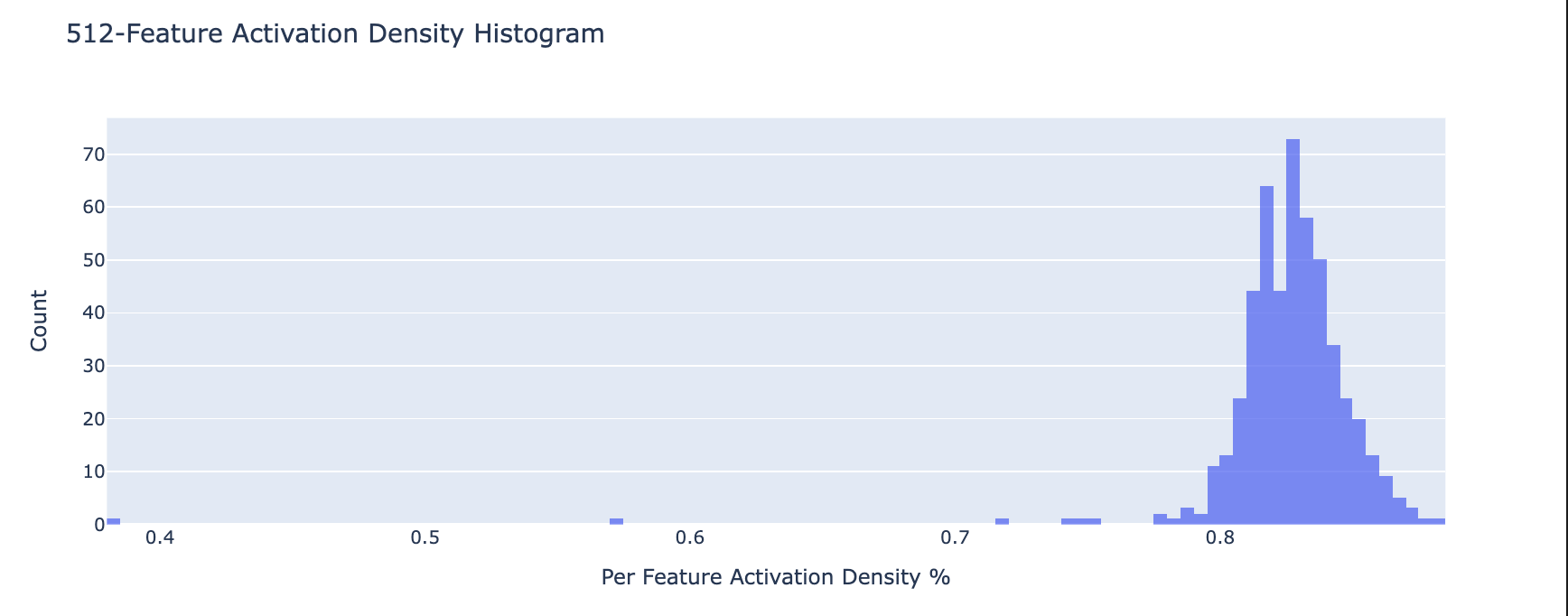
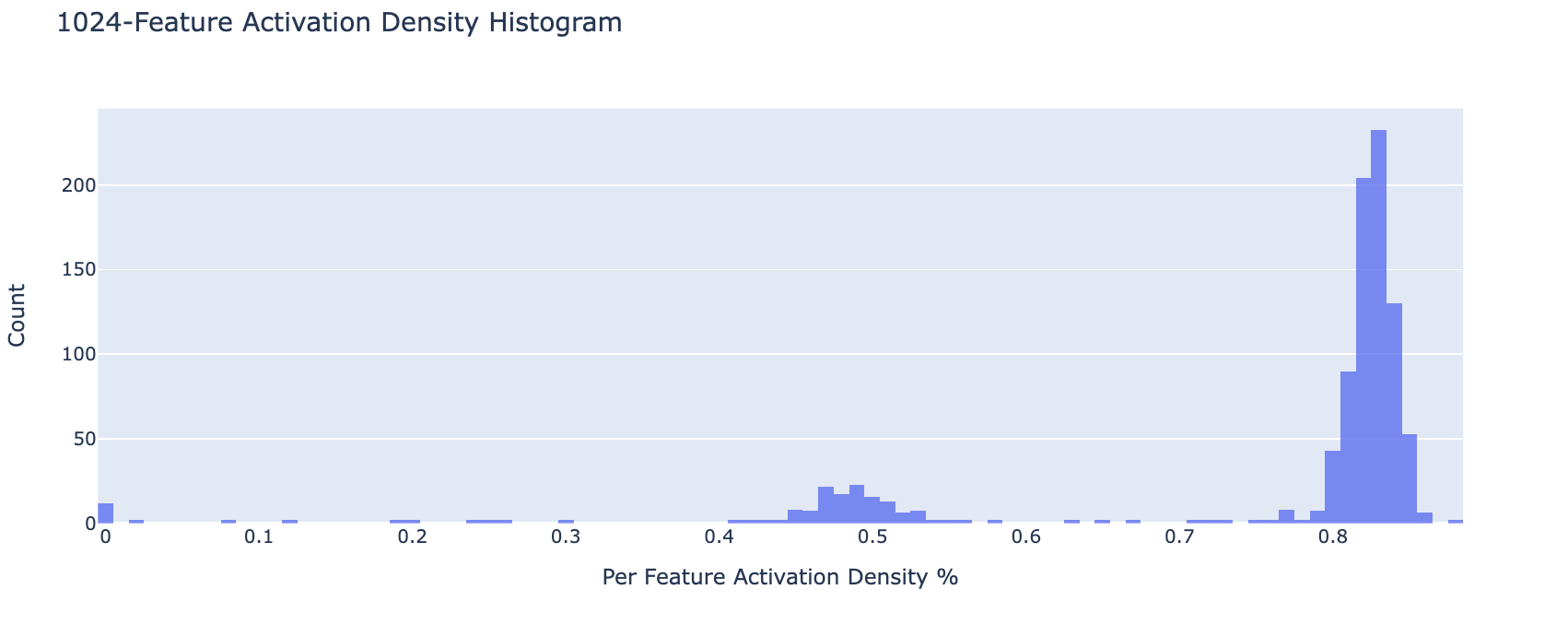
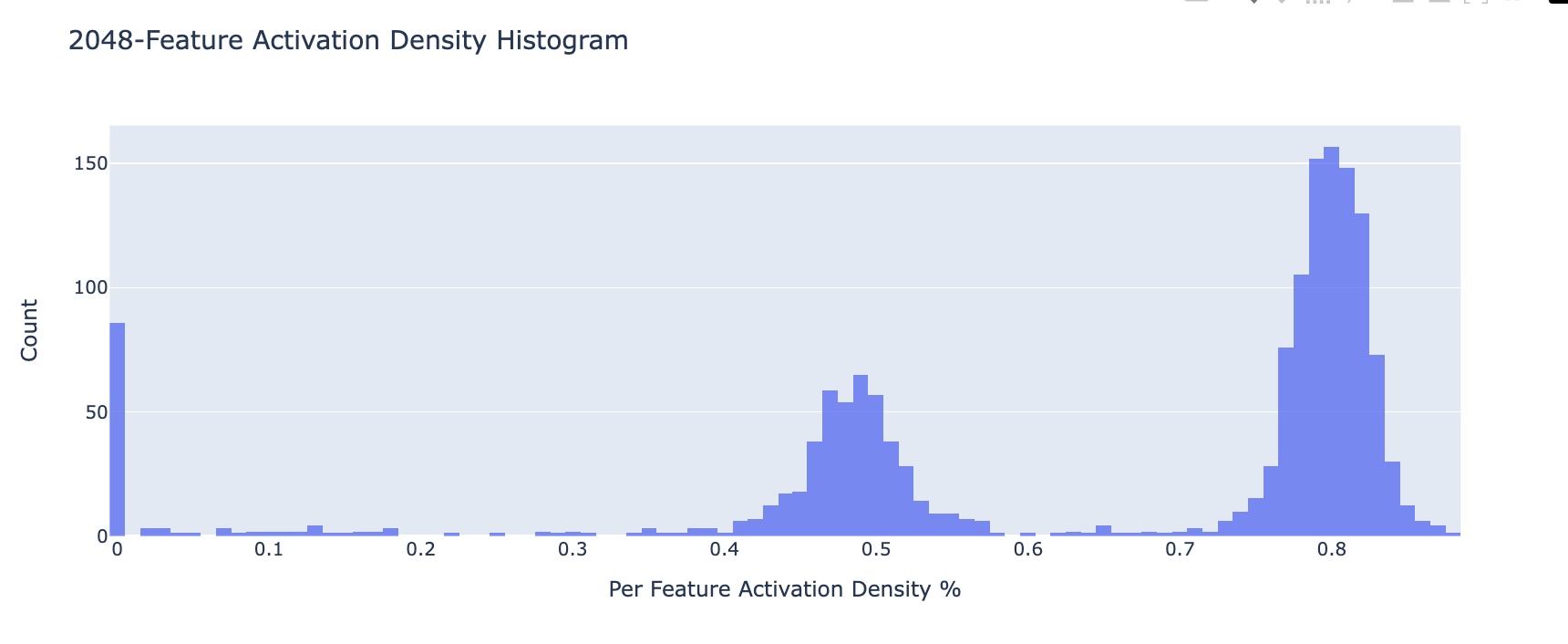
Below is a histogram (normalized w.r.t. number of features) of the distribution of feature density. Each bin corresponds to features that are active on the given bin percentage of inputs (i.e. % features that have % feature density). Notice that for the model with 16834 features a large percentage are dead/ultralow density (see blue bar next to 0). The feature density histogram for each feature is given in the appendix.
What is happening with all these dead features are they simply ultra-low density? If we look at the log histogram of feature density filtering everything above 0, it looks like few features are of density or below. The vast majority never are less active than .
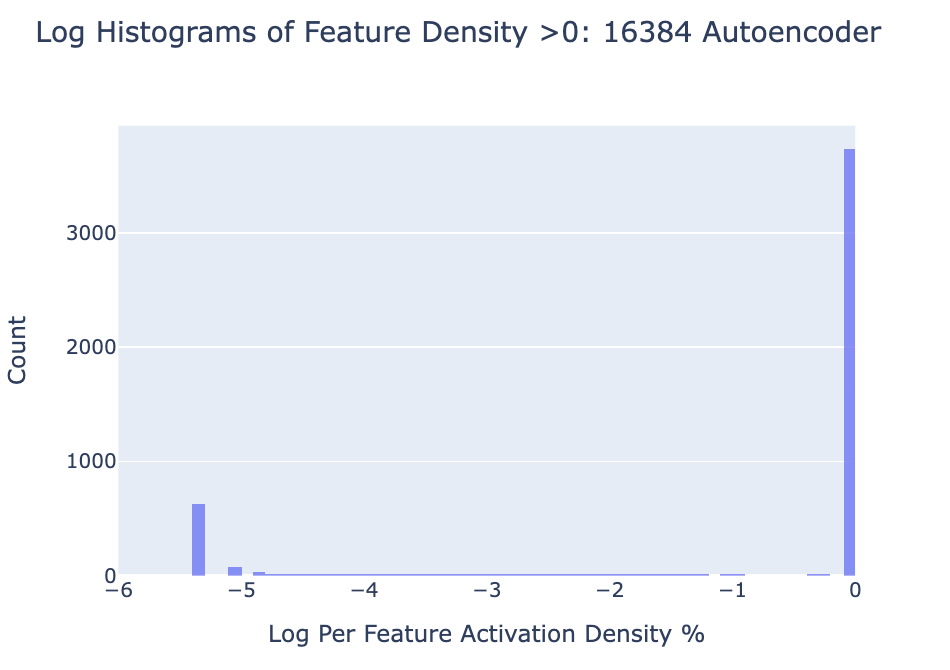
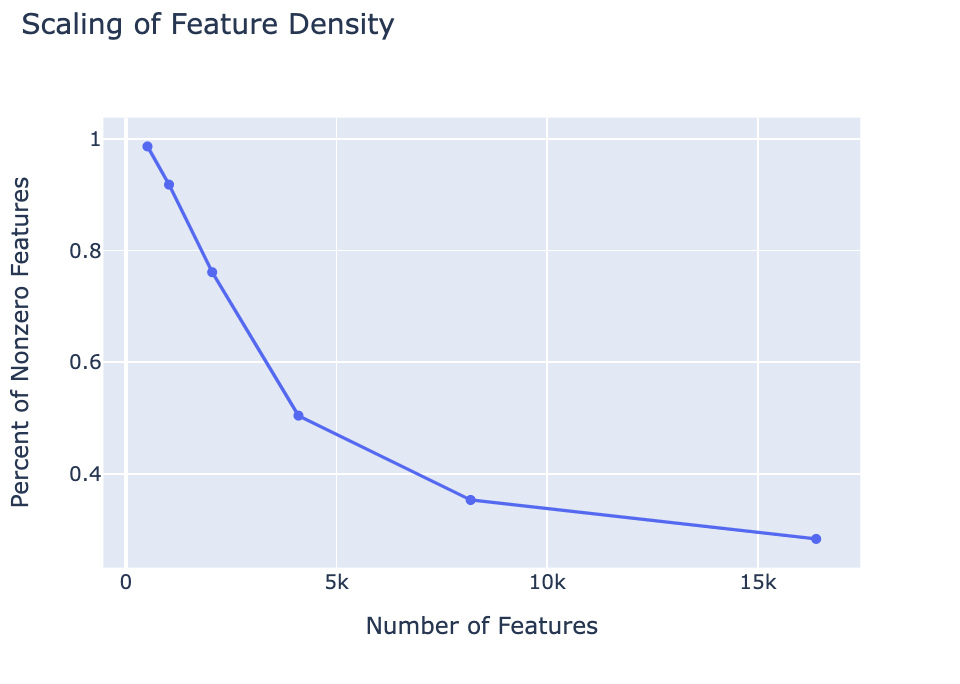
We find that the number of nonzero features scales inversely with the number of features used in our model. It seems that the number of “active” features stays relatively constant while the number of features grows leading to an inverse relation of nonzero to total features as autoencoder size grows.
References
Ayonrinde, K. (2023). Dictionary Learning with Sparse AutoEncoders. Blog post. Retrieved from https://www.kolaayonrinde.com/2023/11/03/dictionary-learning.html
Bricken, T., Templeton, A., Batson, J., Chen, B., Jermyn, A., Conerly, T., Turner, N., Anil, C., Denison, C., Askell, A., Lasenby, R., Wu, Y., Kravec, S., Schiefer, N., Maxwell, T., Joseph, N., Hatfield-Dodds, Z., Tamkin, A., Nguyen, K., McLean, B., Burke, J. E., Hume, T., Carter, S., Henighan, T., & Olah, C. (2023). Towards Monosemanticity: Decomposing Language Models With Dictionary Learning. Transformer Circuits Thread. Retrieved from https://transformer-circuits.pub/2023/monosemantic-features/index.html
Cunningham, H., Ewart, A., Riggs, L., Huben, R., & Sharkey, L. (2023). Sparse Autoencoders Find Highly Interpretable Features in Language Models. arXiv preprint arXiv:2309.08600.
Appendix
Dataset
Below is our dataset composition in terms of the number of rows. Keep in mind that languages like Japanese have many more tokens per line than English. This biases our identified features to languages with a higher number of tokens per letter, i.e. Japanese, Arabic, etc.
| Data source | Proportion |
|---|---|
| C4 | 70.42 % |
| Simple Wikipedia | 1.41 % |
| English Wikipedia | 14.08 % |
| French Wikipedia | 3.52 % |
| Arabic Wikipedia | 3.52 % |
| Yoruba Wikipedia | 1.06 % |
| Japanese Wikipedia | 2.46% |
| TinyStories | 3.52 % |
Feature Density Plots At Each Autoencoder Scale
If you'd like to cite this article, you can use this:
@misc{Ayonrinde2024dictionary-learning,
  author = "Kola Ayonrinde, Andrew Gritsevskiy, Hans Gundlach, Derik Kauffman",
  title = "Reading The Dictionary: An Exploration Into the Interpretability of Dictionary Learning",
  year = 2024,
  howpublished = "Blog post",
  url = "https://cavendishlabs.org/blog/dictionary-learning/"
}